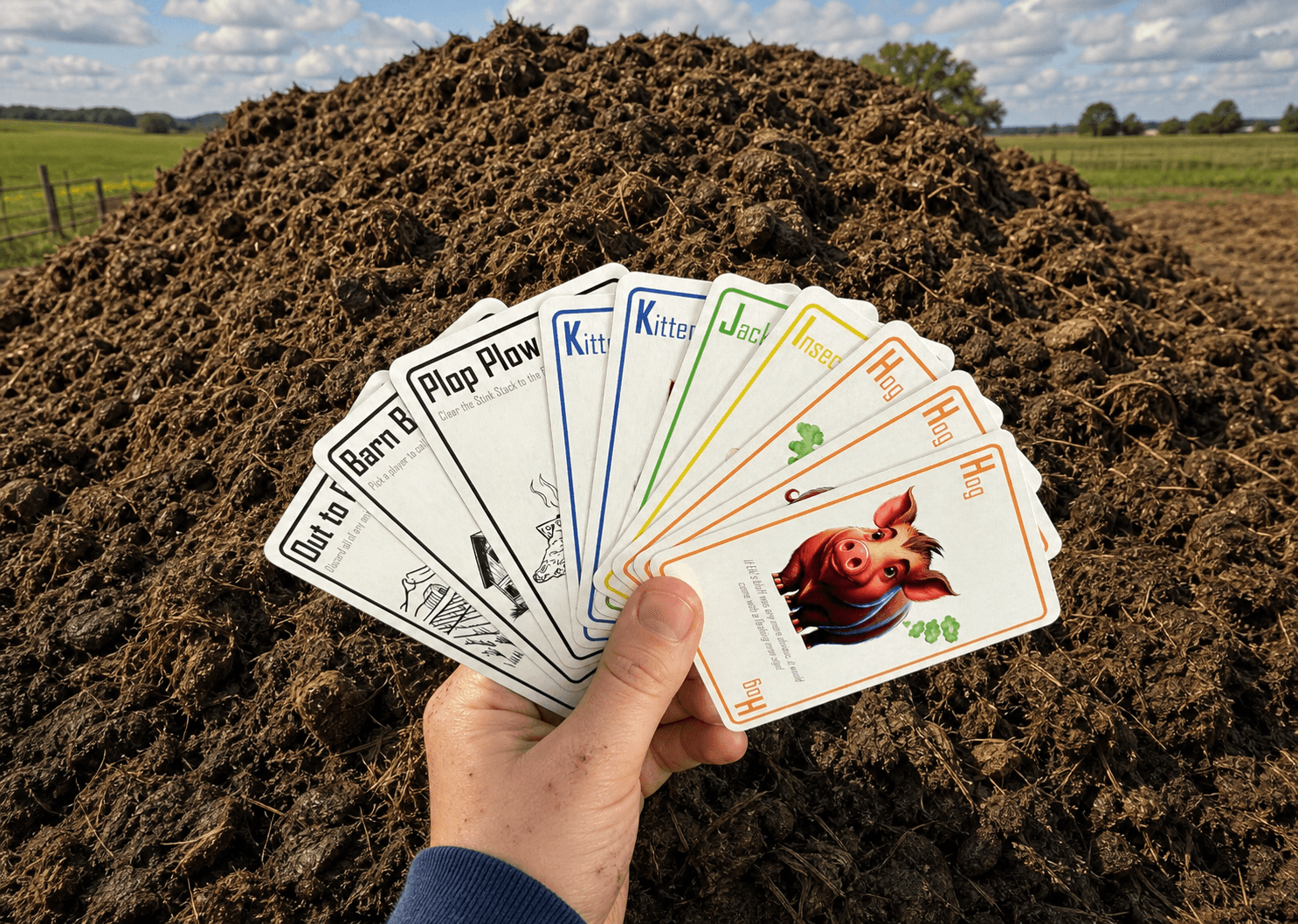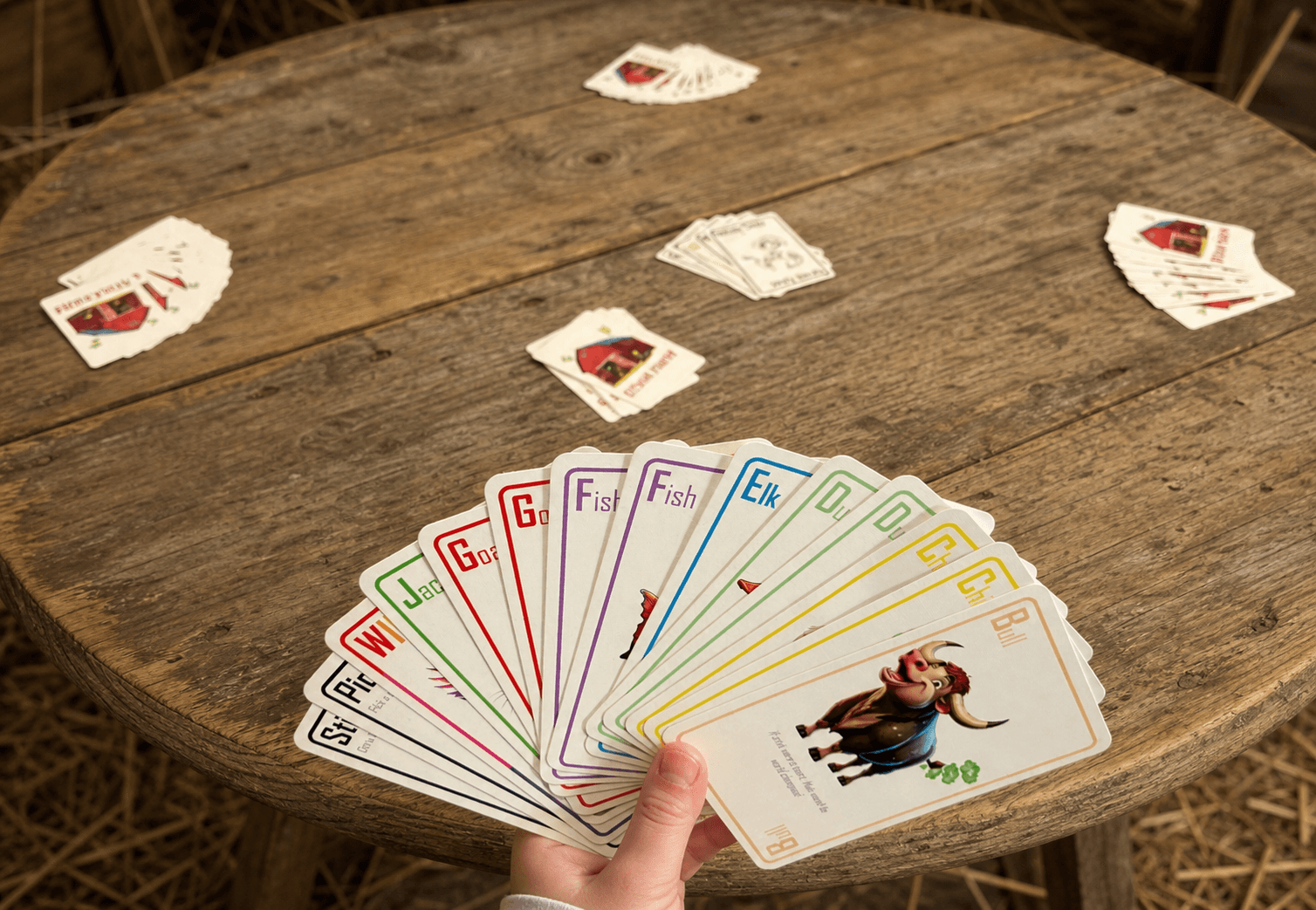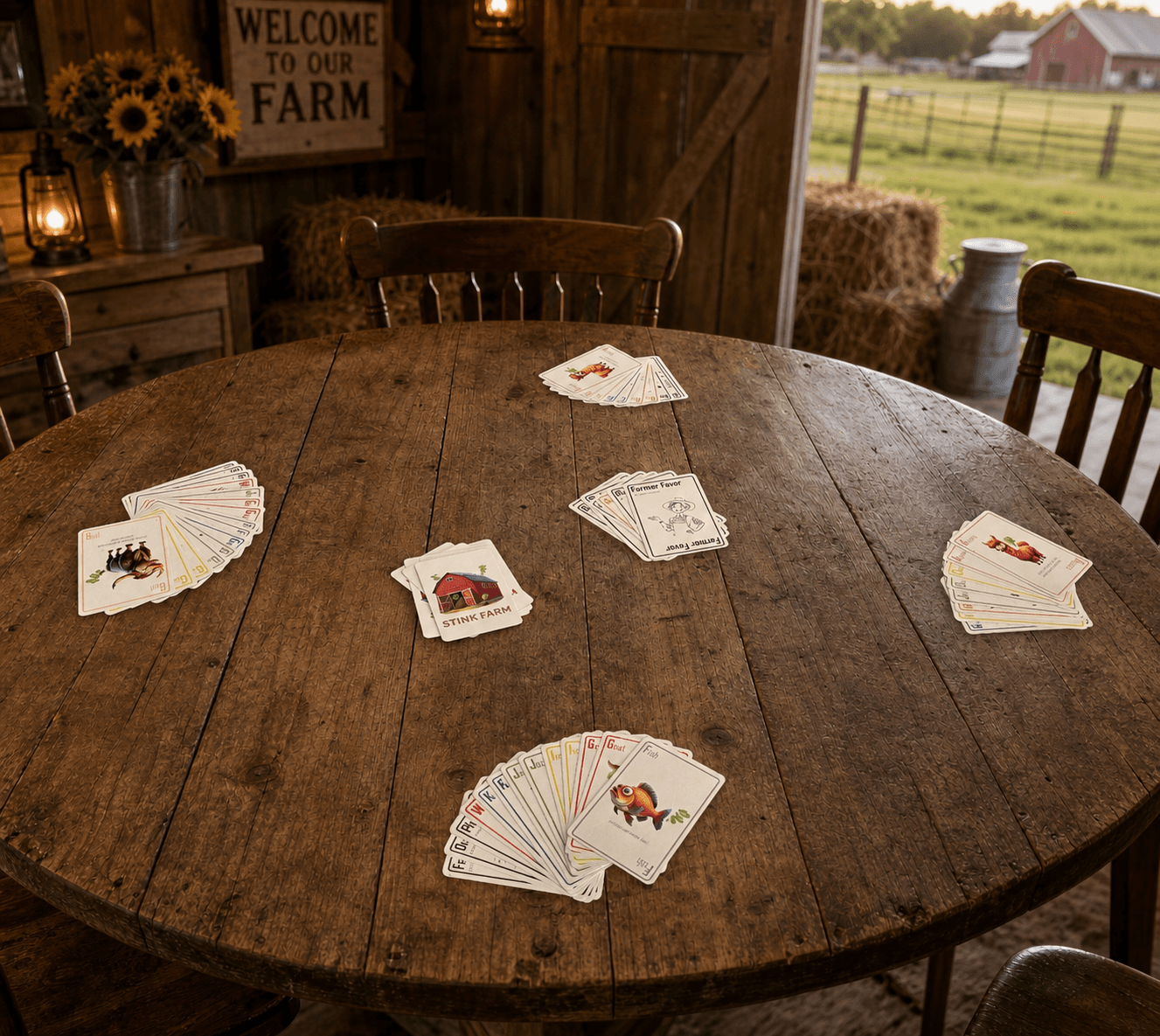
The game's creator, Mike, built Stink Farm with his four boys. Mike grew up with a grandfather who never lost his love for the country smell. On road trips, he'd roll down every window the moment the fields opened up — convinced the whole family needed to breathe it in. His grandmother took it one step further: she'd scoop a cow pie right out of the field and box it up, so her husband could tuck a little piece of the country into his car and enjoy that fresh farm air all week on his commute to the printing press factory in the city, where he spent his career running the presses. That's the kind of family this game comes from.
Growing up, he loved a bluffing card game called BS. The core mechanic was brilliant — play cards face-down, declare what you played, and dare someone to call you out. But it always felt like it was missing something. More strategy. More chaos. More laughs. And definitely a theme the whole family could get into.
The idea was simple: take the bluffing mechanic everyone loves, give it a farmyard makeover, and build something with real strategy and real silliness baked in. Animals. Action cards. And enough stink for everyone to scoop.
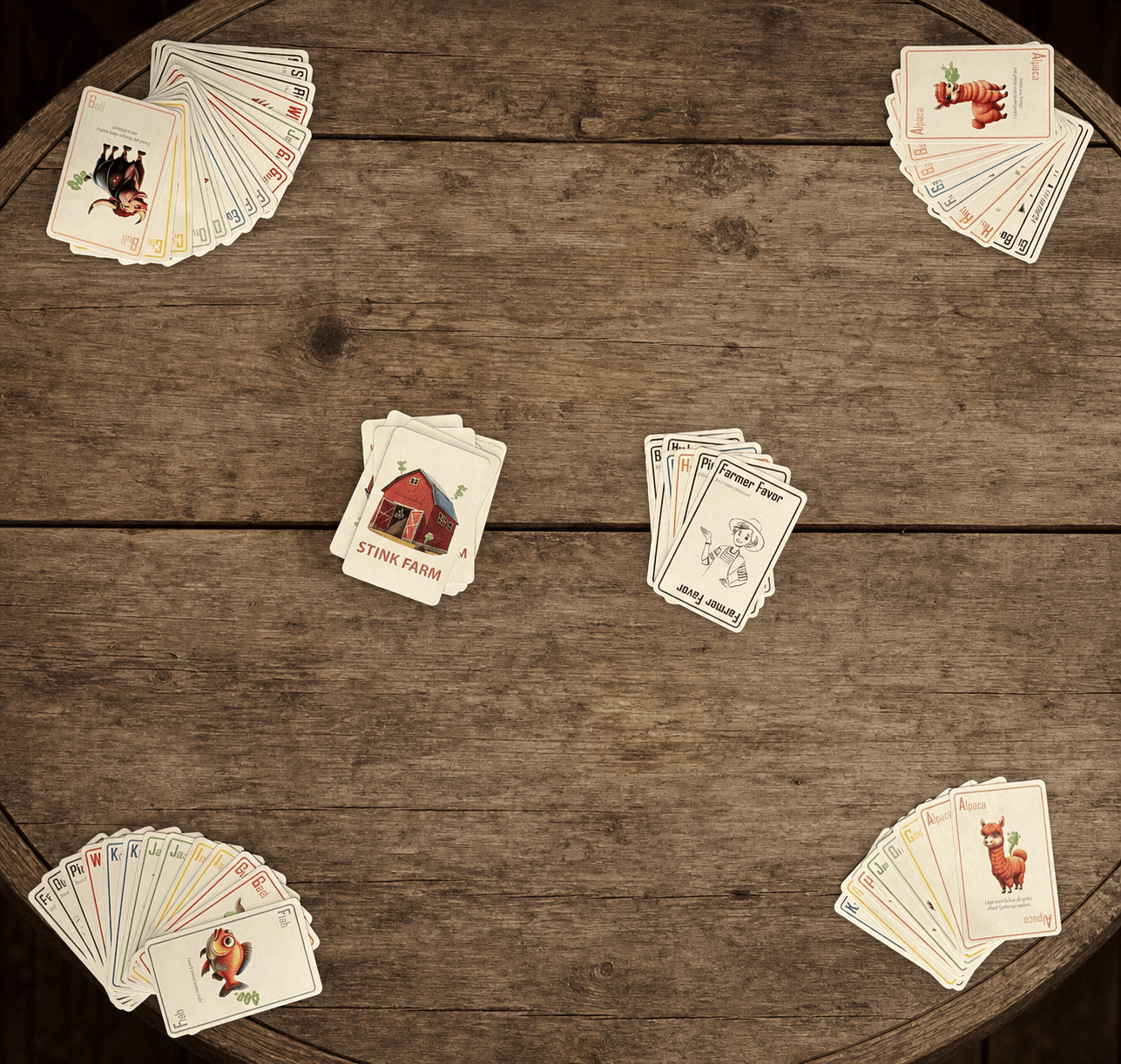
The first version of Stink Farm was hand-drawn cards at the kitchen table. Rough, fast, and immediately hilarious. They loved shouting “Cow Pie!” to bust each other's bluffs, and ideas for funny animals and awesome action cards were flowing fast. It was rough around the edges, but the fun was undeniable.
Over months of playtesting, the game got tighter. New card types. Better balance. Actual rules written down instead of “you know, the rules.” The Mike and his four boys didn't just playtest it — they built it. If a card mechanic wasn't fun, they said so. If a card was boring, it got cut.
The 62-card deck you're holding today is the version that survived every kitchen table test. It's the version that made a teenager put down his phone. That made grandparents snort-laugh. That turned a normal Tuesday night into a memory.
It wasn't just playtesting around the kitchen table, either. Mike built a computer simulation that played out thousands of games of Stink Farm on its own — testing card ratios, bluff frequency, and how often calls actually paid off — to see how the rules held up at scale, not just across a handful of family game nights. One metric he watched closely: the median and maximum number of turns a game ran, to make sure Stink Farm stayed in that 15–30 minute sweet spot instead of dragging on or ending too fast to build any real tension.
Manufacturing had its own gauntlet. Mike made an early decision to work with a U.S. printer instead of the cheaper more common route than many indie games take — a choice with real extra hurdles (cost, safety testing, minimum runs) that took months longer to sort out. It felt right given his grandfather's decades running the presses at a printing factory. Made in America, printed the way his grandfather would have appreciated.
“The goal was simple: make something the whole family would actually want to play. Something funny. Something strategic. Something packed with opportunities to bluff, get busted, and do it all over again.”
Stink Farm is named for the obvious reason. On the farm, things smell. In the game, your bluffs smell worse. The person holding the most stink at the end? They've got some explaining to do.
This is a family game, built by a family, tested on a family. If your family is anything like ours, you're about to find out exactly who the biggest bluffer in the house is. (Spoiler: it's probably not who you think.)